

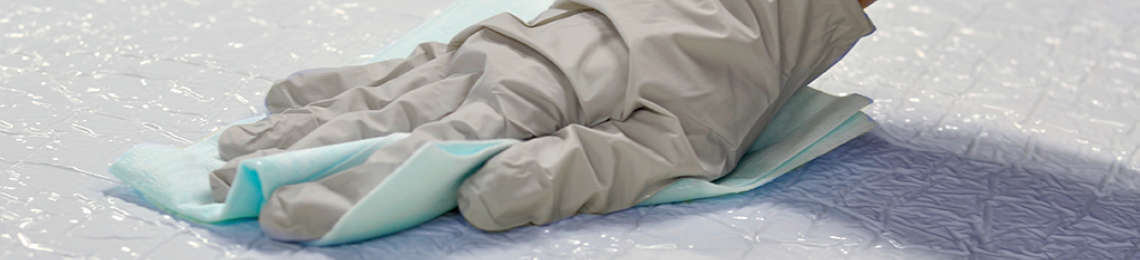
Close-up of a gloved hand cleaning the surface of a Lentex hygiene mattress with disinfectant to ensure good infection control.

Infection Control – The Mattress as a Barrier

Related blog posts

More deaths than in traffic accidents: The hidden danger in our hospital beds

Is your mattress a Trojan horse? The truth about the hidden infection risk in healthcare

2,000 hidden entry points for bacteria – the truth about sewn seams

White Paper

White Paper: Evidence-Based Pressure Injury Prevention
Explore what current clinical evidence reveals and examine how evidence-based mattress engineering and design can contribute to a safer care environment.

Suggestions for procurement documents
A smart checklist for procuring mattresses with a focus on pressure relief.

Would you board a flight with an airline that experiences a fatal crash every six weeks? Unlikely. Yet, within healthcare, a crisis of similar proportions silently unfolds daily. In Sweden alone, healthcare-associated infections (HAIs) claim approximately 1,500 lives annually—significantly outnumbering fatal traffic accidents[1]. Despite these stark figures, the primary patient contact surface is frequently overlooked: the medical mattress.
Below, we examine why conventional mattresses leak, define the clinical phenomenon of "strikethrough," and demonstrate how an uncompromised hygienic barrier can save lives.

The Silent Vector for Contamination in Healthcare

While protocols for disrupting chains of infection heavily prioritize hand hygiene and the environmental disinfection of high-touch surfaces, patients frequently spend upwards of 20 hours a day in bed. This prolonged, continuous contact makes the medical mattress a critical risk zone in healthcare environments.

Research from the Columbia University School of Nursing reveals a stark reality: if a bed’s previous occupant harbored an infection, the risk of the subsequent patient contracting the same pathogen increases significantly, with studies indicating odds up to 5.83 times higher [2]. This demonstrates that conventional decontamination protocols and material selections frequently fail to "reset" the baseline infection risk during patient turnover.

Seams—The Vulnerable Pathway for Infection

A common misconception is that a medical mattress cover provides complete fluid impermeability simply because the textile itself is waterproof. However, a hygienic barrier is only as secure as its weakest point. In conventional mattresses, this critical vulnerability lies within the stitched seams.

When a cover is fabricated with stitched seams, the material is inherently perforated by thousands of needle punctures—a conventional medical mattress often contains more than 2,000 of these micro-perforations. Through a physical phenomenon known as capillary action (the wicking effect), contaminated fluids and pathogens—including blood, urine, and viral particles—can migrate along the sewing thread and penetrate directly into the underlying mattress core. This internal contamination can occur even when the external surface appears completely pristine and decontaminated [5].

The Trojan Horse: The Phenomenon of Strikethrough

In clinical environments, the phenomenon of "strikethrough" refers to a critical barrier failure where biological fluids either chemically degrade the internal coating of the cover through hydrolysis, or directly penetrate it via stitched seams.

The result is a literal Trojan Horse within the care environment. While the mattress exterior may appear perfectly intact and visually decontaminated, pathogens proliferate unchecked inside the foam core. Remarkably, a single gram of contaminated mattress foam can harbor up to 10 billion bacteria. When a subsequent patient occupies the bed, their body weight compresses the core, forcefully expelling these microorganisms into the patient room as an invisible, infectious aerosol—a clinical risk phenomenon known as the "bellows effect."

The U.S. Food and Drug Administration (FDA) has issued explicit safety alerts regarding this exact hazard, warning healthcare providers that biological fluids routinely penetrate cover seams and zippers without leaving any visible external evidence of internal contamination [3].

The Paradox of "Breathable" Mattresses: The Risk of Mold Contamination

While the concept of "breathable" materials is widely promoted, it can introduce severe hygienic risks in clinical environments. When moisture vapor transfers through the cover but cannot efficiently escape, it condenses into liquid directly within the foam core.

When relative humidity exceeds 75%, mold spores germinate and proliferate rapidly. Exposure to mold within the clinical bed environment can trigger a wide spectrum of adverse health effects, ranging from asthma exacerbations and respiratory tract infections to cutaneous rashes and cognitive difficulties [4]. Consequently, a truly hygienic medical mattress must feature a completely impermeable barrier—not a "breathable" construction that permits moisture ingress into the core.

Our Solution: Lentex – Seamlessly Integrated Surface Technology

To effectively disrupt chains of infection and eliminate hidden reservoirs of contamination, minimizing critical risk zones within the care environment is paramount. Järven’s proprietary technology addresses this clinical imperative by completely eliminating stitched seams from the mattress design.

  • Zero Needle Punctures With Lentex technology, the hygienic outer layer is welded directly to the foam core, creating a completely seamless encapsulation. This design entirely eliminates both stitched seams and zippers, leaving zero physical vulnerabilities where bacteria and other pathogens can accumulate.
  • Wipe-and-Go: Because the surface architecture is entirely homogeneous and non-porous, the mattress permits rapid, high-level cleaning and disinfection in situ directly at the point of care. This streamlined workflow drastically minimizes patient room turnaround times and completely eliminates the complex logistical burdens, labor costs, and cross-contamination risks associated with removing and laundering traditional textile covers.
  • High-Visibility Design: Simplifying Contamination Detection In its official safety communications, the FDA has explicitly highlighted the systemic risks associated with dark-colored mattress coverings, noting that they frequently mask blood and other biological fluids, making them visually undetectable during routine inspections. Järven directly addresses this critical vulnerability by utilizing light-colored surface materials engineered to optimize visual contrast. This high-visibility design empowers healthcare professionals to rapidly identify signs of contamination and initiate immediate corrective protocols—serving as a vital line of defense in maintaining a hygienic clinical environment.

Clinical Evaluation Checklist: Supporting Mattress Hygiene Protocols

Could your department's mattresses be functioning as hidden risk zones? Here are three critical assessment criteria to evaluate during your next clinical safety round:
  • Visual inspection Inspect the cover thoroughly for any visible punctures, tears, or mechanical degradation. Additionally, evaluate the mattress for dark spots or shadowing beneath the surface layer; these are critical indicators of fluid penetration and internal moisture ingress.
  • Seam Integrity Assessment Examine all stitched seams for visible staining, discoloration, or organic accumulation. Discoloration along the stitching indicates that fluid migration into the textile fibers has likely occurred, establishing a capillary channel for contamination that standard surface disinfection cannot remediate.
  • Zipper and Internal Core Evaluation: Unfasten the closure mechanism to inspect both the internal zipper track and the underlying foam core. The presence of component corrosion (rust), internal staining, or detectable malodor indicates that the protective barrier has failed. In these scenarios, the mattress represents an active microbial reservoir and must be decommissioned immediately in compliance with institutional infection control protocols.

Regulatory and Clinical References

  1. Healthcare-associated infections (HAIs) in Sweden. Municipalities and Regions of Sweden (SKR) and the National Board of Health and Welfare. Measurements show that just over 50,000 patients annually are affected by HAIs, resulting in approximately 1,500 deaths. The cost of a single HAI is estimated at around 107,000 SEK.
  2. Risk of infection when changing patients Cohen, B. et al. (2018). Association Between Healthcare-Associated Infection and Exposure to Hospital Roommates and Previous Bed Occupants with the Same Organism. Infection Control & Hospital Epidemiology. The study demonstrates a 583 % increased risk of infection if the previous patient in the bed was carrying an infection.
  3. Warnings concerning mattress covers U.S. Food and Drug Administration (FDA). (2013/2017). Safety Communication: Covers for Hospital Bed Mattresses – Learn How to Keep Patients Safe. FDA warns that fluids and body fluids can penetrate mattress covers without visible signs, which can lead to cross-contamination. .
  4. Health risks from mould Exposure to mould spores in healthcare environments (caused by trapped moisture in mattresses) is linked to symptoms such as asthma, respiratory infections, and skin irritation. .
  5. Risks with seams and wicking Studies published in Infection Control & Hospital Epidemiology highlight the risks associated with capillary action (wicking) in sutures and seams in medical textiles, where fluid can travel through the barrier layer.

Related blog posts

White Papers

Evidence-based pest control
Gain deeper insight into life-saving technology. In this White Paper, we review clinical studies and provide you with a smart checklist to use when procuring pressure-relieving mattresses.

Suggestions for procurement documents
A smart checklist for procuring mattresses with a focus on pressure relief.