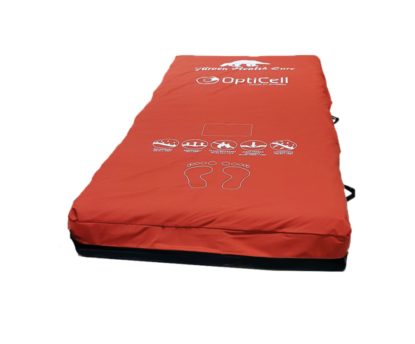
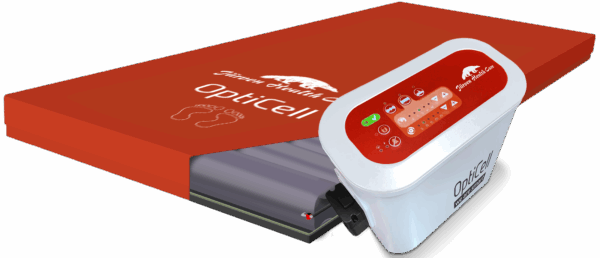
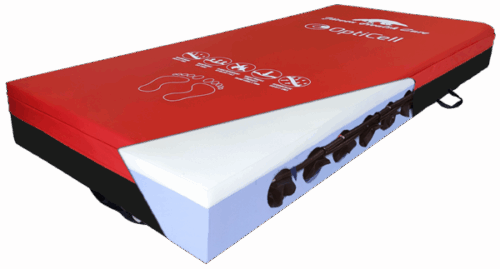
OptiCell Tender free up valuable time and save staff's backs by automating heavy, manual turning. Instead of disturbing the patient's sleep with physical repositioning, the mattress takes care of the repositioning gently around the clock.
OptiCell SMART is a series of mattresses developed to reduce technical stress and allow staff to spend their time on care rather than on complicated settings. The systems automatically adapt the pressure to the patient, and if a heel or a wound requires pressure relief, individual air cells can be disconnected with a quick manoeuvre without heavy lifting. It is an intuitive and reliable product series developed to be a dependable tool in daily care, even during the most demanding shifts.
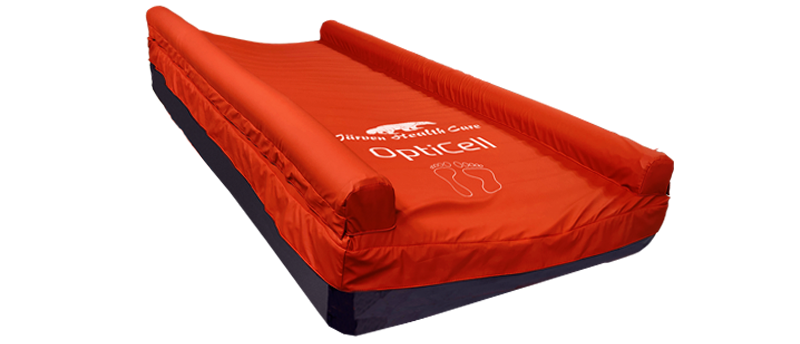
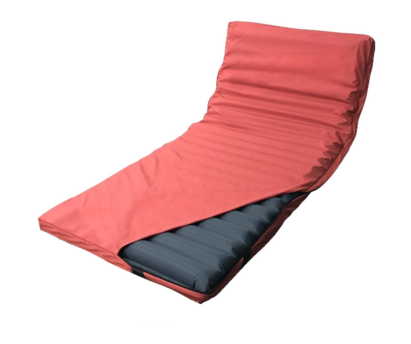
OptiCell Series 2 is an air mattress system developed to facilitate daily care work and provide reliable protection against pressure ulcers up to category 4. Through automatic pressure adjustment and a stable care position, the physical strain during patient-related tasks is reduced, while individual air cells can be easily disconnected for total relief without heavy lifting. The system's light design and welded hygiene covers also simplify cleaning, saving time and creating a safe care environment for both staff and patients.
OptiCell Soft Series is a series of static air mattresses designed to facilitate the selection of the right mattress in various care situations and provide reliable protection against pressure ulcers up to category 4.
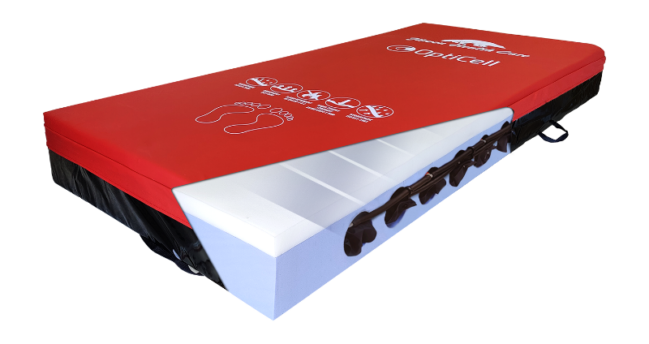
Air1 Series is a hybrid mattress that combines a foam base with a fully enclosed air system to provide reactive and even pressure relief. As the air cells are interconnected, air automatically and directly moves from pressure-exposed areas to less loaded zones when the patient moves. The mattress distributes counterpressure quickly and effectively. In independent tests, the mattress has achieved top-class pressure values.
OptiCell Tender frees up valuable time and facilitates care work by automating repositioning, reducing the need for heavy manual turning. The mattress handles repositioning continuously around the clock without the patient needing to be moved manually. This creates a calmer work environment where you can be confident that the patient has good conditions for effective pressure ulcer care – without constant manual interventions from you.
OptiCell SMART is a series of mattresses developed to reduce technical stress and allow staff to spend their time on care rather than on complicated settings. The systems automatically adapt the pressure to the patient, and if a heel or wound area requires pressure relief, individual air cells can be disconnected with a simple manoeuvre without heavy lifting. It is an intuitive and reliable product series developed to be an aid in daily care, even during the most demanding shifts.
OptiCell Series 2 is an air mattress system developed as an aid in daily care work, for the prevention and treatment of pressure ulcers up to category 4. Through automatic pressure adaptation and a stable nursing position, the physical strain during patient-adjacent tasks is reduced, while individual air cells can be easily disconnected for total relief without heavy lifting. The system's light design and welded hygienic covers also simplify cleaning, saving time and contributing to a safe care environment for both staff and patients.
OptiCell Series Soft is a series of static air mattresses developed to be a aid in preventive and treatment Care work up to and including category 4. The system automatically adjusts pressure to the patient, and if a heel or sore area requires pressure relief, you can disconnect individual air cells with a quick manoeuvre, without heavy lifting and with a simple hand motion.
The Serie Soft is an intuitive and functional product range developed to be a reliable aid in daily care.
OptiCell Air1 is developed to reduce technical complexity and free up time for clinical work and close patient care. Through a closed, foam-free system with interconnected air cells, pressure distribution occurs reactively and dynamically. Air is automatically moved from loaded areas to manage immersion and envelopment. It is a functional and flexible product designed to serve as an aid in the care environment. In addition to pressure ulcer prevention, the closed system contributes to hygiene efforts; as no air is released from the mattress, the spread of airborne particles in the room is reduced.
FAQ
A static air mattress (such as the OptiCell Soft series as an example) redistributes the patient's body weight over a large surface by conforming to the body's contours, but the air pressure in the mattress remains constant.
In contrast, an alternating pressure system (such as OptiCell SMART or Tender) utilizes a pump to actively inflate and deflate the air cells in recurring cycles. This continuous alternation shifts the pressure points over time, providing support for patients with significantly reduced mobility who cannot reposition themselves independently.
The selection depends on the patient's overall needs, mobility, and clinical assessment. As a general guideline, our static air mattresses (e.g., Soft PRO) are an option for patients at risk of pressure ulcers up to and including Category 3. For patients with a higher risk or existing pressure ulcers up to and including Category 4, an alternating pressure system, such as the OptiCell Series 2 or the SMART series, is typically recommended. If the patient also requires frequent and gradual repositioning around the clock, OptiCell Tender (up to Category 4) with its integrated turning function is an appropriate choice.

The mattresses are supplied with OptiTex, a 4-way stretch cover manufactured from polyurethane (PU). The cover is designed for hygiene and to facilitate cleaning and disinfection. It features welded seams and a waterproof zip on all four sides to prevent fluid ingress into the mattress. The elastic surface supports the mattress's pressure-relieving properties, enabling patient immersion without causing surface tension.
Both materials are established in healthcare environments, featuring distinct physical properties. Nylon is a high-tensile material that provides structural stability and firmness to the air cells. In contrast, TPU (Thermoplastic Polyurethane) is a highly flexible and elastic material. This higher elasticity enhances anatomical contouring, allowing the mattress to conform to the patient's body profile to support pressure redistribution.
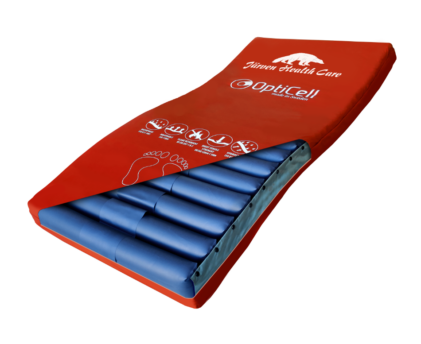
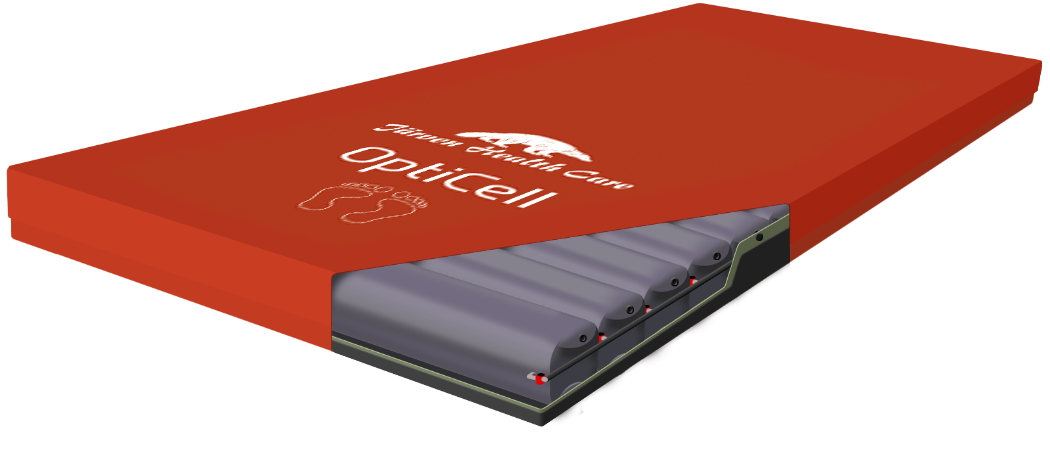
Cell-on-Cell technology features a dual-layer air cell construction. The lower layer serves as a static safety base that remains continuously inflated, even in the event of a power failure. The upper layer dynamically manages pressure by inflating and deflating within the alternating pressure cycle. This dual-layer configuration provides a safety margin that prevents the patient from bottoming out, thereby supporting patient safety in the clinical environment.
Multi-Zone Relief is a feature designed to provide targeted pressure offloading for vulnerable anatomical areas, such as the heels. Healthcare professionals can manually disconnect and deflate individual air cells directly beneath the patient. This eliminates interface pressure at the specific site, and is performed without the requirement for tools or heavy lifting.
It also allows for the replacement of air cells with the patient on the mattress.
You might also be interested in